Why Does My Daughter Look Fine at School and Fall Apart the Moment She Gets Home? The Hidden Cost of ADHD Masking
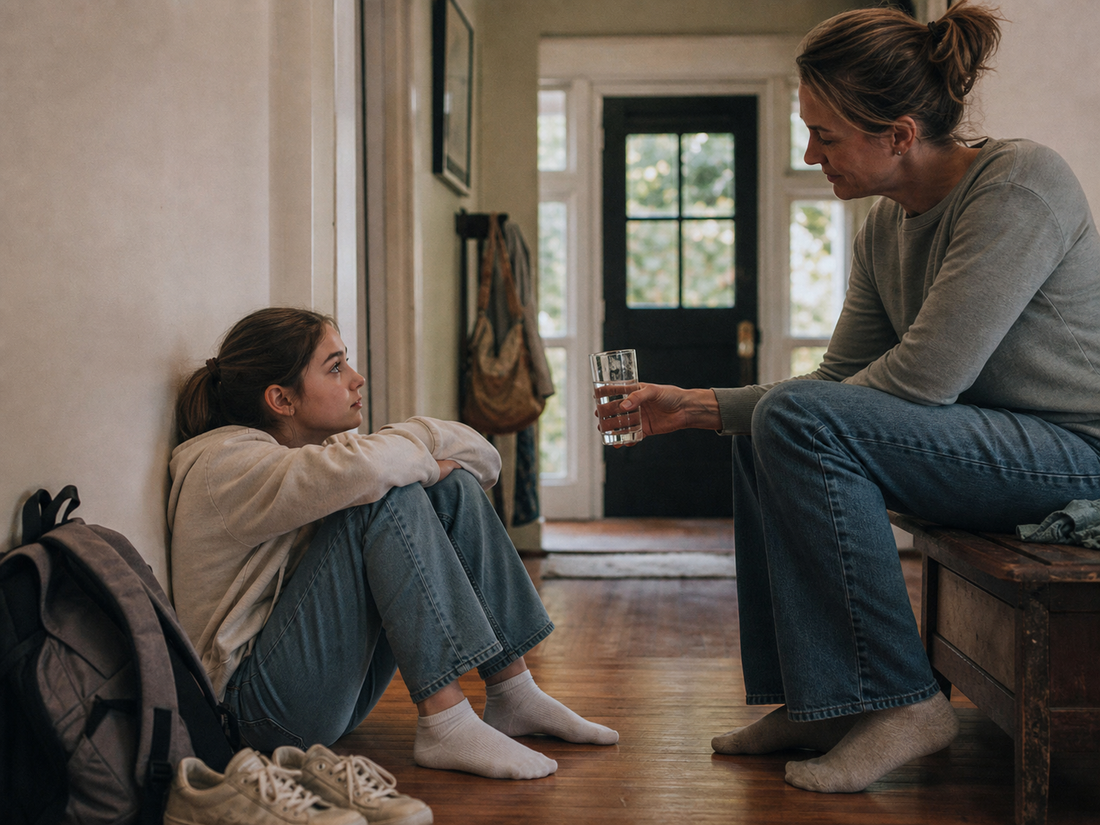
Her teacher describes her as quiet, thoughtful, and responsible. She brings home good grades. She rarely causes trouble. Then she walks through your front door, drops her backpack, snaps at her brother, cries because the wrong cup is on the table, and says she cannot do one more thing.
Parents can feel confused by the contrast. If she can hold it together for seven hours at school, why does home receive the collapse?
One possible answer is not that home is the problem. Home may be the first place she feels safe enough to stop performing.
Girls with ADHD are especially likely to have symptoms overlooked in childhood, according to the National Institute of Mental Health. Some learn to compensate, copy peers, suppress movement, overprepare, stay painfully quiet, or spend enormous energy avoiding mistakes. Recent qualitative research with girls describes this kind of impression management and social camouflaging at school. The research is still developing, and “masking” is not itself a diagnosis. But the lived pattern deserves careful attention.
The school day may cost more than it appears
Success is not always proof that a task is easy. Sometimes it is proof that a child has built an expensive system for surviving it.
A girl may track every social cue because she is afraid of being called weird. She may borrow a classmate’s organization system without understanding how to maintain it. She may check her work repeatedly, laugh when she misses an instruction, or wait until nobody is watching to ask what the assignment was. She may sit on restless legs, pick at a sleeve, doodle continuously, or hold every emotion until the final bell.
None of those behaviors confirms ADHD. Anxiety, learning differences, sleep problems, autism, stress, depression, sensory needs, bullying, and other factors can create similar exhaustion. A professional evaluation looks across settings, development, health, and history.
But if your daughter repeatedly arrives home depleted, do not let good behavior at school end the conversation.
Why the collapse happens at home
After school, several needs can collide:
- hunger after a day of delayed or distracted eating;
- fatigue from monitoring behavior and attention;
- sensory overload from noise, lights, touch, and constant proximity;
- the effort of remembering assignments, materials, and social expectations;
- medication timing that may need discussion with her prescriber;
- the emotional release that comes when she reaches a safe person.
The final demand may be tiny—“Hang up your coat”—but it lands on a system that has no flexible capacity left. The cup is not the whole reason for the tears. It is the moment the remaining thread breaks.
This does not mean every outburst should control the family. It means regulation may need to come before correction.
Create a landing, not an interrogation
Many parents greet a child with loving questions: How was school? What homework do you have? Did you turn in the form? Why is your lunch untouched? For an overloaded child, love can sound like another oral exam.
Experiment with a predictable landing period. Fifteen to thirty minutes might include a snack, water, comfortable clothing, quiet movement, music, sitting with a pet, or simply not talking yet. Some children need connection; others need space. Ask when she is calm:
“When you come home tired, what helps first: food, quiet, movement, or sitting near me without questions?”
A landing period is not a reward for yelling. It is part of the transition plan. Family expectations can resume after her body has had a chance to arrive.
Do not praise the mask more than the child
“You are my easy child.” “You never cause trouble.” “I never have to worry about you.” These sentences often sound like praise. They can also become an assignment: stay easy, hide the need, do not disappoint anyone.
Try praising actions without turning them into an identity she must protect:
- “You asked for clarification even though it felt awkward.”
- “You noticed that the room was becoming too loud and used your break.”
- “You told me the assignment was confusing instead of pretending.”
- “You worked hard today. You do not have to perform for me now.”
The goal is not to remove every coping skill. Some strategies are useful. The goal is to notice when coping requires a child to disappear.
Ask the school better questions
“Is she behaving?” is too narrow. A student can be compliant and still be struggling.
Ask questions that reveal effort:
- Does she begin independent work without watching other students first?
- How often does she need an instruction repeated privately?
- Does she complete work during class or finish it later?
- Does she lose materials, miss directions, or hesitate to ask for help?
- What happens during unstructured time, group projects, lunch, and transitions?
- Is perfectionism slowing her work?
- Does she seem unusually tired, tearful, or tense by afternoon?
Bring a simple two-week record: sleep, breakfast, medication timing if applicable, school events, arrival-home mood, hunger, homework duration, and recovery time. Patterns are more useful than a single terrible Tuesday.
Build an after-school sequence with fewer traps
A realistic sequence might be:
- Arrive: backpack goes in one visible place.
- Refuel: snack and water before questions.
- Release: twenty minutes of quiet, movement, or low-demand connection.
- Preview: look at homework together without beginning everything.
- Choose: one short first task and one planned break.
- Close: return finished work to the backpack immediately.
The American Academy of Pediatrics encourages families to examine every step of the homework chain: knowing assignments, bringing materials home, planning work, checking completion, and turning it in. “Do your homework” hides all of those steps. A breakdown in one link can make the whole evening look like refusal.
When emotions become disrespectful
A child can be exhausted and still need a limit. Try naming both realities:
“I believe that you are completely spent. You may be quiet, cry, or ask for space. You may not call your sister names. We will talk after your snack.”
This avoids two common errors: treating distress as manipulation, or treating distress as permission to harm everyone nearby.
Later, keep the repair small. What happened? What did your body need? Who was affected? What can be repaired? What should the after-school plan change tomorrow?
Faith should make home safer for honesty
Christian girls can learn early how to appear agreeable, helpful, grateful, modest, and composed. Those qualities can be beautiful when they grow from freedom. They become heavy when a child believes love depends on never becoming inconvenient.
Psalm 139 presents a God who knows a person before she explains herself well. That truth can shape the atmosphere of a home: you do not have to hide the hard part to remain known and loved.
A simple prayer after school might be:
“God, thank You for bringing us home. Help us tell the truth about what today cost. Give us gentleness for the next small step.”
Do not use prayer to rush her out of an emotion. Let prayer create room for truth, not another expectation to become calm on command.
When to seek evaluation or additional help
Consider speaking with your child’s pediatrician or a qualified mental-health professional when the pattern is persistent, intense, or affecting learning, friendships, sleep, eating, self-worth, or family safety. Mention both the successful school presentation and the home collapse. Girls’ symptoms can be missed when adults look only for disruptive hyperactivity.
If school functioning is affected, families in the United States can ask about evaluation and support under Section 504 or the Individuals with Disabilities Education Act. Eligibility depends on the individual student; an ADHD diagnosis does not automatically determine one specific plan. The U.S. Department of Education notes that a student who is not eligible under IDEA may still need evaluation under Section 504.
Urgent statements about self-harm, hopelessness, abuse, or not wanting to live require immediate adult attention and appropriate crisis or emergency support. A calm report card never makes those words less serious.
A question worth carrying
Instead of asking only, “How do I stop the after-school meltdown?” ask: “What is my daughter doing all day that nobody can see?”
The answer may change homework, school communication, treatment, household expectations, or simply the first twenty minutes after she comes home. Most of all, it can change what she learns about home: this is not the place where you must perform perfectly. This is where truth can finally receive support.
Sources and further reading
- National Institute of Mental Health: ADHD in adults and missed diagnosis among girls and women
- Identity work among girls with ADHD: impression management and social camouflaging in school
- American Academy of Pediatrics: ADHD and homework
- U.S. Department of Education: Resource guide on students with ADHD and Section 504
This article is educational and cannot diagnose ADHD, masking, anxiety, or another condition. Seek individualized medical, mental-health, and school guidance for your child.
Keep exploring with Hearts Notes
Find more practical faith support in our ADHD & Faith library. You can also browse Hearts Notes by journey: Learn & Discover, Heal & Restore, Grow Together, Give & Gift, Play & Enjoy, and Storybooks.
For something more interactive, visit all Hearts Notes quizzes. For new videos, ideas, and encouragement, follow Hearts Notes TV on YouTube and @fromheartsnotes on Instagram.
A next step for you
-
-
Free shipping
Somatic Grace: Calming Your Nervous System with God’s Truth
Regular price From $9.99 USD -
Free shipping
Newborn Personalized Christmas Blessing Gift Book
Sale price $49.99 USD Regular price$59.99 USD17% OFF -
Free shipping
Personalised Christian Wish Book For Babies: 1st Birthday, Newborn or Baptism
Sale price $40.99 USD Regular price$49.99 USD18% OFF