
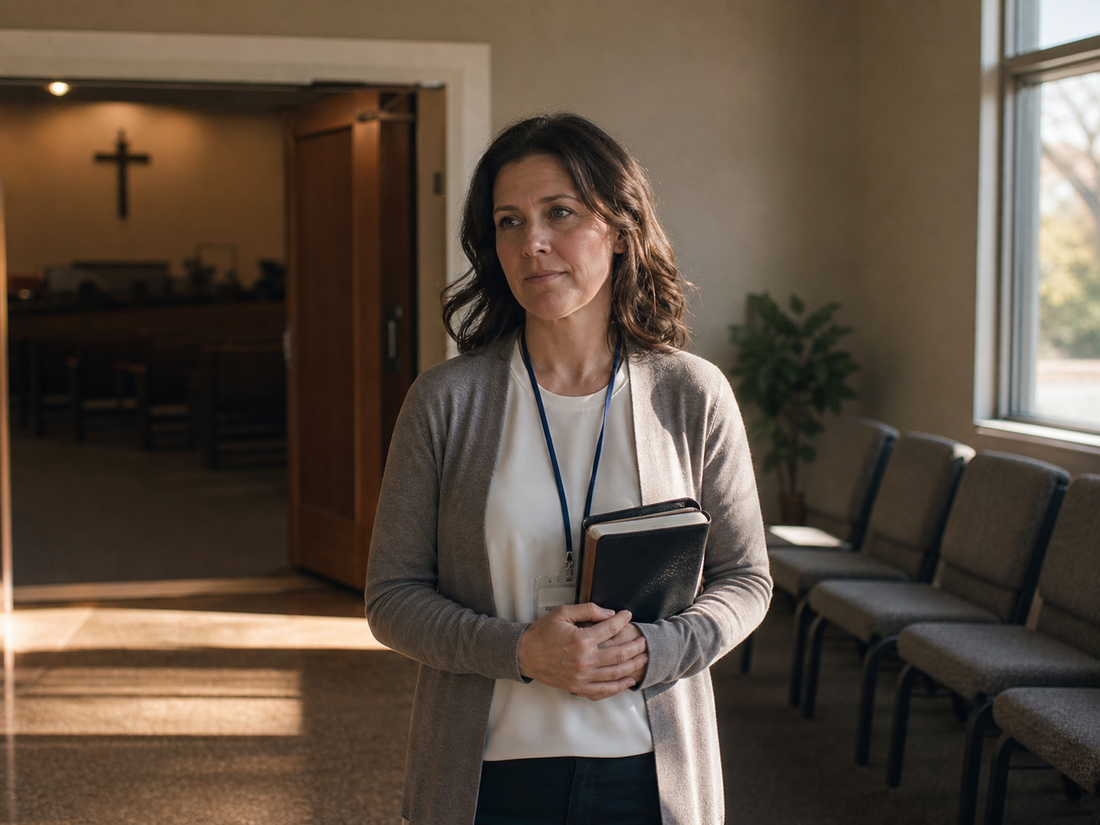
Everyone at Church Thinks I Have It Together. They Do Not See What ADHD Costs Me at Home
You remembered the name tags, answered the group message, and found the missing microphone batteries. Someone smiled and said, “You are so organized.” You smiled back, knowing there are unopened bills under the passenger seat and wet laundry in the machine for the second time.
Church may be the place where you feel useful, loved, and close to God. It may also be where the performance becomes hardest to put down. You arrive early so nobody sees how often you are late. You say yes because urgency helps you function. You become indispensable, then go home too depleted to make dinner.
For women with ADHD, appearing composed can require extensive compensation or masking: suppressing visible restlessness, rehearsing, overpreparing, copying expected behavior, and hiding the effort or confusion underneath. The public result can look competent. The private cost can include exhaustion, anxiety, shame, and delayed recognition of support needs.
Reliability can be real and still be expensive
Your church contributions are not fake. You may genuinely be gifted at noticing people, responding in a crisis, generating creative ideas, teaching, or making newcomers feel welcome. Masking does not mean every strength is an act.
The question is what it costs to maintain the visible version. Do you spend Saturday recovering from Sunday service? Do you agree to tasks while forgetting existing commitments? Does public volunteering leave your family carrying the aftermath? Are you terrified that one missed message will expose you as irresponsible?
A gift that can be offered only through chronic self-erasure needs a different container.
Why women can be missed
ADHD has often been recognized through disruptive behavior more readily associated with boys. Girls and women may present with inattentiveness, internal restlessness, disorganization, emotional distress, or compensatory effort that is less visible. A qualitative study of young women described masking, exhaustion, and the ways social expectations can obscure ADHD experiences.
One study does not describe every woman, and online stories cannot diagnose you. But “You seem so capable” is not a clinical assessment. A person can achieve, serve, parent, and still experience significant impairment or unsustainable effort.
Church culture can reward overextension
Many congregations depend on volunteers, and generous service is meaningful. Problems begin when every need feels like a divine assignment, when “servant-hearted” means never having limits, or when women are quietly expected to carry hospitality, children, meals, emotions, and administration at once.
An ADHD nervous system may respond strongly to novelty, urgency, interest, and immediate social feedback. A last-minute ministry need can feel easier to begin than a routine form at home. Saying yes provides connection and a clear deadline. The cost arrives later.
Not every strong yes is a calling. Sometimes it is an unexamined reflex.
Put a waiting period between the request and your answer
Prepare one sentence before the next opportunity arrives:
- “Thank you for asking. I need to check my existing commitments and reply tomorrow.”
- “I can help once, but I cannot own this role.”
- “I am at capacity this season.”
- “I can contribute for thirty minutes after service, not lead the project.”
Put the request into the same calendar where the rest of your life exists. Ask what preparation, travel, follow-up, and recovery the yes includes. A one-hour event may consume four hours of capacity.
Tell one safe person a more accurate truth
You do not owe your diagnosis or private history to an entire congregation. Begin with one trustworthy person who respects confidentiality and does not spiritualize every difficulty.
“I often look organized here because I overprepare. At home, attention and follow-through are difficult, and I am exhausted from hiding it. I need fewer last-minute requests and clearer written responsibilities.”
A safe response sounds like curiosity and practical care. An unsafe response dismisses ADHD as laziness, announces your story to others, treats medication as spiritual failure, or uses your disclosure to question every contribution.
Ask for specific accommodations
“Please support me” is loving but vague. Useful requests might include:
- Written instructions after verbal planning.
- One named contact rather than several message threads.
- Deadlines earlier than the actual event.
- A role with a clear beginning and end.
- Permission to move or stand during long meetings.
- No same-day requests except genuine emergencies.
The church may not be able to meet every preference. Clear requests at least give leaders something concrete to consider.
Let home receive some of your public compassion
Women sometimes offer limitless patience to ministry teammates and contempt to themselves after arriving home. Try speaking to the private evidence with the same honesty you would offer another woman: “The laundry was forgotten. I am depleted. I need to move it now and remove one commitment from tomorrow.”
Compassion is not pretending bills do not matter. It removes the layer of identity attack that consumes energy needed for repair.
Belonging is not the same as usefulness
First Corinthians 12 describes the church as a body whose members belong to one another through God’s arrangement, not through identical functions. You are not only the person who brings supplies, answers texts, teaches children, or fixes the event.
If stepping back makes you feel that your place will disappear, that fear deserves attention. Healthy Christian community should be able to receive your presence when your hands are empty.
Practice attending one gathering without volunteering. Notice the discomfort. Let someone else carry an item. Receive prayer without immediately offering labor in return. This may reveal how deeply usefulness has become attached to safety.
Faith does not require hiding your brain
Paul’s image of power made perfect in weakness has sometimes been used to romanticize suffering or prevent treatment. Weakness in Christian theology is not a ban on calendars, medication, therapy, coaching, boundaries, or accommodations. Truthful dependence can include receiving skilled care.
A diagnosis does not explain your entire personality. It may offer language for difficulties that moral effort alone did not resolve. If you suspect ADHD, seek a qualified evaluation rather than relying only on social media or a friend’s checklist.
When the mask begins to come down
Do not remove every support and disclose everything at once. Masking may have developed partly for safety. Choose gradual experiments:
- Delay one volunteer answer for twenty-four hours.
- Decline one role outside your current capacity.
- Ask for one written instruction.
- Tell one safe person one accurate sentence.
- Keep one recovery block after demanding service.
- Attend once without making yourself indispensable.
- Notice whether the community makes more room for your humanity.
The aim is not to become careless at church. It is to stop purchasing public reliability with private collapse.
What thoughtful church leaders can do
Leaders do not need to become ADHD clinicians to create a healthier volunteer culture. They can give written role descriptions, realistic deadlines, one point of contact, and permission to decline without spiritual suspicion. They can avoid treating last-minute urgency as proof of commitment and notice when the same capable woman is absorbing every unclaimed task.
A private check-in can ask, “Is this role still sustainable, and what would make it clearer?” That question is better than waiting for a failure and responding with disappointment. Confidentiality should be explicit. A volunteer’s diagnosis or difficulty is not material for a prayer chain without her consent.
Churches can also widen their picture of participation. A person may contribute through one-time creative work, short defined projects, remote administration, prayer, mentoring, hospitality with a partner, or faithful presence that produces no measurable output. The body needs more than its most visible workers.
Notice what your household already knows
Ask the people who live with you what ministry weeks feel like at home. Listen without defending the good purpose of the service. A spouse or child may value your calling and still experience the exhaustion, forgotten commitments, or emotional absence that follows.
This is not an argument that women should remain home or make family comfort the measure of obedience. It is an invitation to count the full cost of a commitment. A sustainable yes should have enough truth in it to include the people who help carry it.
If church service consistently requires your household to rescue, remind, and recover around you, bring that pattern into the discernment. Calling can withstand honest information.
When to seek support
Talk with a qualified healthcare professional when attention, memory, impulsivity, disorganization, emotional distress, or exhaustion is affecting multiple areas of life. Anxiety, depression, trauma, sleep problems, and other conditions may overlap with ADHD and deserve assessment.
Pastoral care can support spiritual and community concerns, while licensed clinicians assess and treat health needs. If a church environment shames treatment, violates confidentiality, or pressures you to remain in unsafe circumstances, seek support beyond that environment.
Sources and further reading
- Peer-reviewed qualitative study: ADHD masking and experiences among young women
- National Institute of Mental Health: ADHD symptoms, diagnosis, and treatment
- CDC: About ADHD
This article is educational and spiritual in nature. It cannot diagnose ADHD or replace individualized medical, mental-health, or pastoral care.
Keep exploring with Hearts Notes
Find more practical faith support in our ADHD & Faith library. You can also browse Hearts Notes by journey: Learn & Discover, Heal & Restore, Grow Together, Give & Gift, Play & Enjoy, and Storybooks.
For something more interactive, visit all Hearts Notes quizzes. For new videos, ideas, and encouragement, follow Hearts Notes TV on YouTube and @fromheartsnotes on Instagram.