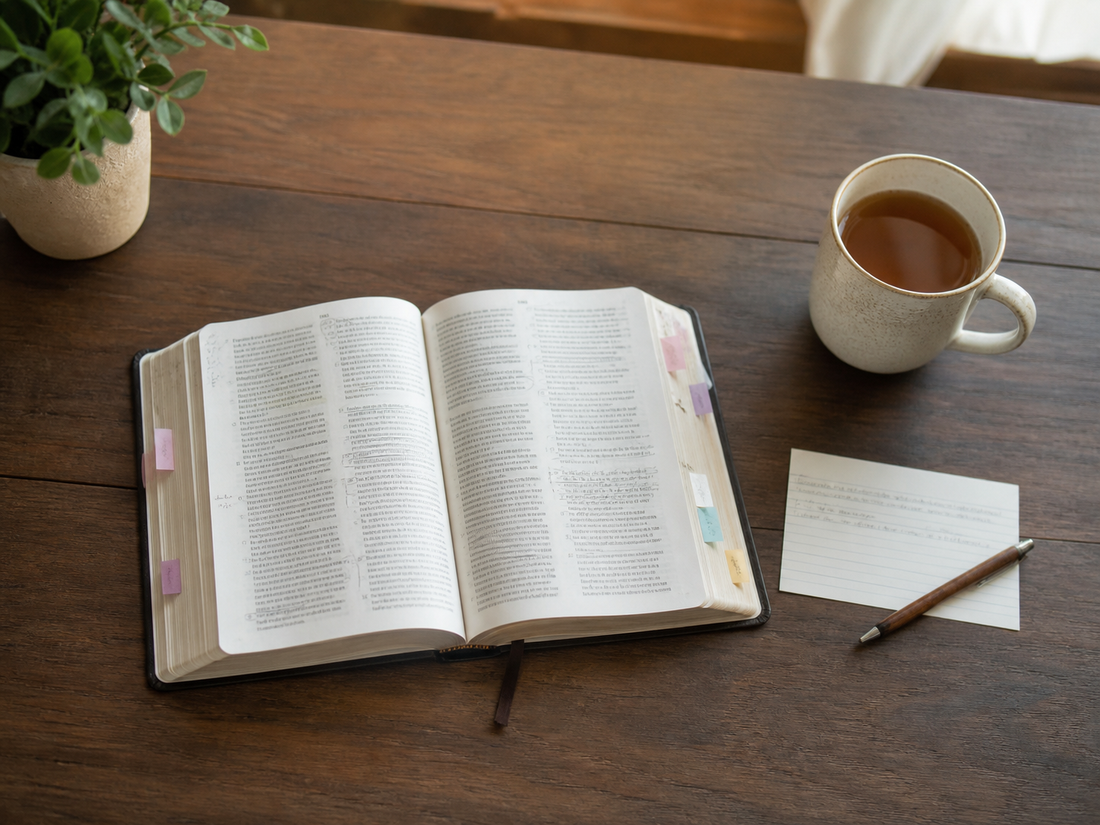
Reading More Is Not Always the Answer: How to Remember What You Read in the Bible
You finish a chapter, close the Bible, and by lunch you can barely explain what you read. The answer may not be another reading plan. It may be changing what happens after the words reach your eyes.
Forgetting does not mean you are unintelligent or spiritually careless. Most information fades when we consume it once and immediately replace it with messages, tasks, videos, and noise. Scripture needs room to become more than content.
1. Read less, twice
A small passage read twice often stays longer than several chapters read quickly. On the first reading, follow the movement. On the second, look for repetition, contrast, cause and effect, or a sentence that carries the heart of the passage.
This is not about lowering the standard. It is about giving attention enough time to form.
2. Retell it without looking
Close the Bible and explain the passage in your own words. If you cannot, open it again. Retelling reveals what you understood and what slipped past you.
For a story, ask: Who was there? What changed? What choice mattered? For a letter, ask: What is the writer explaining, correcting, or encouraging?
3. Attach the truth to a real moment
General ideas are easy to admire and easy to forget. Connect the passage to something specific:
- a conversation you need to have;
- a fear that returns at night;
- a habit you are trying to change;
- a person you find difficult to love;
- a decision that needs patience.
The goal is not to make every verse “about you.” It is to notice where the truth meets the life you are responsible for living.
4. Keep one sentence visible
Write one verse or one true sentence on a note, lock screen, or page you will see again. Return to it at lunch and before sleep. Repetition spaced across the day is more useful than copying a paragraph once and never revisiting it.
5. Say it to someone
Tell your spouse, child, friend, or small group one thing you noticed. Conversation makes you retrieve the idea, put it into language, and hear how it connects with another life.
You do not need to teach a lesson. “This line stayed with me today” is enough.
The one-page memory method
Passage: What did I read?
Picture: What scene or idea can I see?
Point: What is the central truth?
Practice: Where will it meet my day?
Prayer: What will I say to God?
What if you still forget?
Return. Scripture is not a test you pass once. The same passage can meet you differently because you are reading it from a different week, grief, question, or season.
The aim is not perfect recall. It is a growing familiarity with God’s character and story—truth becoming easier to recognize, retrieve, and live.
Find more practical reading rhythms in Bible Study & Faith Learning.
A next step for you
-
-
-
Free shipping
Somatic Grace: Calming Your Nervous System with God’s Truth
Regular price From $9.99 USD -
Free shipping
Newborn Personalized Christmas Blessing Gift Book
Sale price $49.99 USD Regular price$59.99 USD17% OFF