A Bible Timeline Children Can Actually Follow: Teaching the Story Without Losing the Thread
A child can name Noah, Moses, David, Daniel, Mary, and Paul—and still imagine they all lived at roughly the same time.
That is not a failure of memory. We often teach the Bible as a jar of separate stories: one colorful lesson lifted out each week. Children collect characters and morals but never receive the shelf that holds them together.
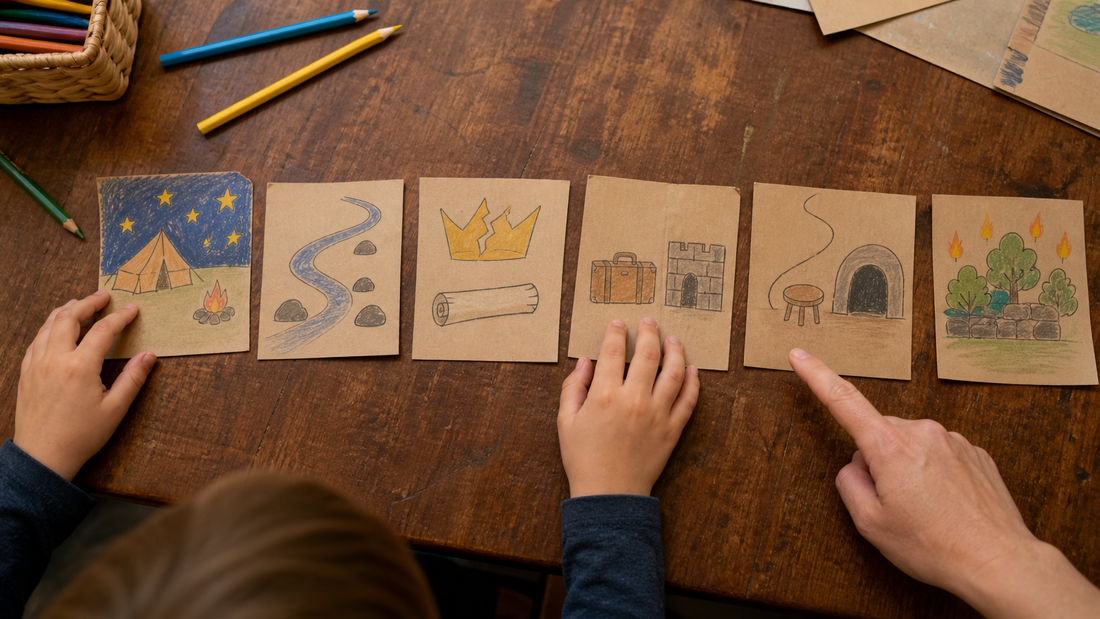
A useful Bible timeline does not begin with dozens of dates. It gives children six visual anchors and one repeated question: Where are we in the story of God and God’s people?
The six-anchor timeline
- Creation and Covenant: God creates; human beings bear God’s image; sin fractures relationship; God begins covenant promises, especially through Abraham’s family.
- Exodus and Law: God rescues Israel from slavery, forms a people, and gives instruction for life with God and neighbor.
- Kingdom and Prophets: Israel’s monarchy rises and divides; prophets call rulers and people back to covenant faithfulness, justice, and hope.
- Exile and Return: Jerusalem falls, many are displaced, and a remnant returns to rebuild while waiting for fuller restoration.
- Jesus and the Gospels: Jesus announces God’s kingdom, teaches, heals, dies, and is raised. Christians understand Israel’s story and promises in relation to him.
- Church and New Creation: The Spirit forms a witnessing community across peoples; the New Testament looks toward God’s final renewal of creation.
Different Christian traditions will describe some connections differently. That is not a reason to avoid the timeline. It is a reason to distinguish the biblical sequence from later interpretive details and to teach with humility.
Why six anchors work
Six is small enough to display on one wall or table and large enough to prevent the most common confusion. Every new story has a home. Ruth belongs in the broad era before Israel’s kings; Elijah speaks during the divided kingdom; Daniel lives in the world of exile; Nehemiah belongs to return and rebuilding; the Gospels come before the early church letters.
Do not demand exact dates first. Ancient chronology can be complex, and Bible translations or study traditions may present details differently. Begin with sequence, setting, and covenant movement. Dates become useful after the child has a story-shaped map.
Anchor one: Creation and Covenant
Picture symbol: a circle of light beside a cluster of stars, then a simple tent.
Teaching sentence: “God makes a good world; people break trust; God begins a rescue-shaped promise through a family.”
Stories to place here: creation, fall, Cain and Abel, flood, Babel, Abraham and Sarah, Isaac and Rebekah, Jacob’s family, and Joseph.
Question: “What promise is God making or keeping in this story?”
Avoid turning Genesis only into heroes to copy. Abraham’s family is complicated. The point is not that God chose flawless people. Children should see both human failure and divine faithfulness.
Anchor two: Exodus and Law
Picture symbol: a path through blue paper and two simple stone shapes.
Teaching sentence: “God hears an oppressed people, brings them out of slavery, and teaches them how to live as a covenant community.”
Stories to place here: Moses’ call, Passover, crossing the sea, wilderness provision, Sinai, the tabernacle, and entry toward the promised land.
Question: “What does rescue make possible—and what kind of people are they learning to become?”
Teach the law after rescue, not as a ladder Israel climbs to convince God to care. Also handle slavery carefully. Do not reduce a history of oppression to a cheerful craft.
Anchor three: Kingdom and Prophets
Picture symbol: a crown with a crack through it and a speaking scroll.
Teaching sentence: “Israel asks for kings; some lead faithfully and many fail; prophets tell the truth and keep hope alive.”
Stories to place here: Samuel, Saul, David, Solomon, the divided kingdom, Elijah, Elisha, Amos, Hosea, Isaiah, Jeremiah, and other prophets according to their setting.
Question: “How are power, worship, and treatment of vulnerable people connected?”
Children often receive David only as the brave boy with a sling. The wider story includes courage, covenant, serious sin, consequences, and lament. Age-appropriate teaching can be truthful without becoming graphic.
Anchor four: Exile and Return
Picture symbol: a suitcase or torn map beside a partly rebuilt wall.
Teaching sentence: “God’s people experience displacement and loss; they learn to seek God away from home; some return and rebuild, but the story still feels unfinished.”
Stories to place here: Jerusalem’s fall, Daniel and friends, Ezekiel’s visions, Esther in Persia, Ezra, and Nehemiah.
Question: “How do people remember who they are when home and life have changed?”
This anchor helps children understand why the opening of the New Testament carries political occupation, longing, and expectation. Christmas does not arrive in a historical vacuum.
Anchor five: Jesus and the Gospels
Picture symbol: a path, a table, and an empty tomb.
Teaching sentence: “Jesus announces God’s kingdom in words and actions, gathers disciples, gives his life, and is raised.”
Stories to place here: birth narratives, baptism, teaching, healings, parables, meals, conflict, crucifixion, resurrection, and ascension.
Question: “What does this show us about Jesus and the kingdom he announces?”
Keep the Gospels distinct. They tell the story with different emphases and arrangements. A timeline can display their shared movement without pretending each event is easy to synchronize.
Anchor six: Church and New Creation
Picture symbol: many small flames over different faces, leading toward a green city-garden.
Teaching sentence: “The Spirit sends a diverse community to witness to Jesus, and Christians live in hope of God renewing all things.”
Stories to place here: Pentecost, the early church, Stephen, Philip, Peter, Paul’s journeys, New Testament letters in their community settings, and Revelation’s final vision of renewal.
Question: “How does this community learn to follow Jesus together, and what hope pulls it forward?”
Avoid teaching Acts as if the church immediately became perfect. Its arguments, cultural boundaries, courage, generosity, and failures help children see that Christian community has always required the Spirit’s guidance and human repentance.
A reusable 15-minute classroom activity
Make six large anchor cards with pictures and short labels. Place them in order on the floor. Give children smaller cards representing people, places, or events. One at a time, a child places a card beneath an anchor and explains the choice.
If the answer is wrong, say, “Let’s find the clues.” Ask:
- Is Israel in the land, leaving it, or returning?
- Is there a king?
- Has Jerusalem’s temple been built, destroyed, or rebuilt?
- Does the story happen before, during, or after Jesus’ earthly ministry?
- Is this person writing to an early church?
The goal is reasoning, not public embarrassment. Let children move a card after discussion. A corrected placement is visible learning.
Adapt the timeline by age
Ages 4–7
Use pictures, movement, and the six teaching sentences. Place one familiar story each week. Repeat sequence aloud. Keep difficult material simple but truthful: “The king used power to harm people” is better than either graphic detail or pretending nothing serious happened.
Ages 8–11
Add maps, major biblical books, and cause-and-effect questions. Let children create symbols. Compare two stories within one anchor. Begin distinguishing narrative, poetry, prophecy, Gospel, and letter.
Middle school and older
Add approximate dates, empires, the divided kingdoms of Israel and Judah, the Second Temple period, Gospel perspectives, and the historical setting of letters. Invite students to mark where scholars or traditions differ rather than hiding complexity.
Three errors a timeline should prevent
- Moral-of-the-week teaching: Biblical people become flat examples instead of participants in a larger story of covenant, kingdom, exile, Messiah, church, and renewal.
- Jesus appearing disconnected: The Gospels are treated like an unrelated second book rather than arriving within Israel’s story and hope.
- The church becoming the ending: The story closes with us instead of God’s promised renewal, justice, resurrection, and presence.
A script for introducing any new lesson
“Today’s story belongs under [anchor]. Before it happens, [one sentence of prior context]. The people are facing [one real tension]. As we read, listen for [one story question]. Afterward, we will ask how this part connects to the story we already know.”
That thirty-second orientation may do more for comprehension than another worksheet. Children cannot connect a story if adults never show where the connection lives.
Use a resource as a doorway, not a substitute
Steps of the Savior can help children visually follow the life and ministry of Jesus. Place that material clearly inside anchor five, then keep extending backward to Israel’s story and forward to the church and new creation. A strong resource supports reading; it should not replace opening the biblical text, asking questions, or naming context.
Teachers should check every timeline against the Bible translation, curriculum expectations, and doctrine of their church or school. If you adapt this six-anchor method, say what you changed and why. Children can learn that faithful readers take both story and interpretation seriously.
Keep exploring with Hearts Notes
Use Steps of the Savior as a visual companion, then browse Hearts Notes by journey: Learn & Discover, Heal & Restore, Grow Together, Give & Gift, Play & Enjoy, and Storybooks.
Visit all Hearts Notes quizzes, watch visual Bible lessons on Hearts Notes TV, and follow @fromheartsnotes on Instagram.
A next step for you
-
-
-
Free shipping
Somatic Grace: Calming Your Nervous System with God’s Truth
Regular price From $9.99 USD -
Free shipping
Newborn Personalized Christmas Blessing Gift Book
Sale price $49.99 USD Regular price$59.99 USD17% OFF