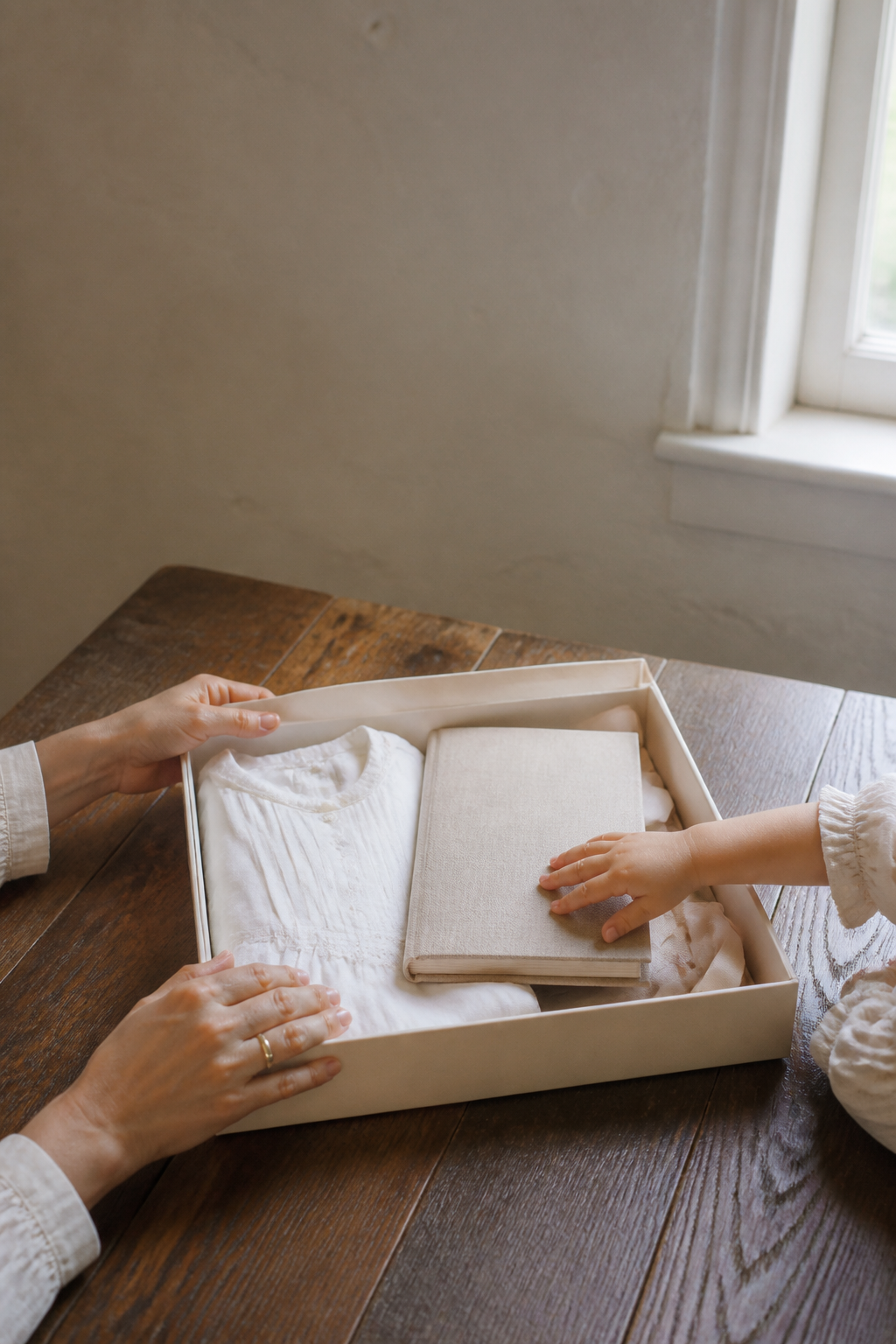
Christening Gifts Parents Will Keep Forever
The christening invitation is on the counter. You want to give something beautiful, but not another object the parents must politely display, store, or quietly donate three years from now.
The christening gifts families keep are rarely the ones that shout the loudest on the day. They are the gifts that identify the giver, preserve a particular moment, and remain understandable when the child is old enough to ask, “Who gave me this, and why?”
That means the safest choice is not automatically silver, expensive, personalized, or traditional. It is a gift with a future use and a human story attached.
First, ask what the family is celebrating
“Christening” and “baptism” are sometimes used for the same service. The Church of England, for example, explains that there is no difference between its christening and baptism services. In the United States, families and churches may use different language, and some congregations celebrate infant dedication rather than infant baptism.
Before choosing a Bible translation, saint medal, cross, baptismal shell, candle, or denominational book, ask one quiet question:
“I’d love to choose something that fits the meaning of the day for your family. Is there a tradition, Bible translation, or kind of keepsake you would prefer?”
This does not ruin the surprise. It prevents the more awkward surprise of giving a symbol the family does not use.
Christian traditions differ, but they repeatedly place the emphasis beyond the ceremony. Catholic teaching describes parents and godparents helping a baptized child grow in faith. The Episcopal baptismal service similarly speaks about supporting a child through prayer, example, and Christian formation. A meaningful gift can point toward that continuing relationship without pretending the object itself will create it.
Use the KEEP test before you buy
At Hearts Notes, we use four questions to separate a lasting keepsake from attractive clutter.
K — Kinship: Does the gift reveal who it came from?
A child may receive several crosses, frames, books, or blankets. The one that survives usually carries evidence of a relationship: a letter in an aunt’s unmistakable voice, a grandmother’s chosen verse and explanation, or a book signed by the people who gathered that day.
Personalization can help, but the child’s name alone is not kinship. Add the giver’s name, relationship, date, place, and one sentence explaining the choice.
E — Endurance: Can it physically and emotionally last?
Look at construction as carefully as decoration. Can a book lie open without cracking? Can the message be written in permanent ink? Is a fabric item washable, or is it meant to be preserved? Can a small object be stored without losing an unidentified loose part?
Emotional endurance matters too. Avoid wording that assigns the child a personality, career, or flawless spiritual future. “May you always know you are loved” can grow with a person. “You will always be Mommy’s perfect angel” may not.
E — Everyday meaning: Will the family know what to do with it?
A keepable gift has a life after the photographs. A children’s Bible can be read. A wish book can collect family words. A framed blessing can include a note about where it belongs. A baptism candle can become part of an anniversary ritual if that practice fits the family’s church tradition.
If the object is purely ceremonial, provide a way to store it and record its meaning. Otherwise, the parents inherit another unexplained item.
P — Personal words: Did you leave something only you could say?
Two sincere sentences can make an ordinary book irreplaceable. Write what you noticed about the family, what you hope to model, or how you intend to remain present. Do not borrow a grand promise you cannot keep.
“On your christening day, I watched your parents hold you with such tenderness. I hope this book reminds you that you entered a family already eager to help you grow in faith and love. I will keep showing up with listening ears, honest answers, and room for your questions.”
Seven christening gifts with a reason to keep them
1. A personalized book that collects more than a name
A personalized baptism book becomes substantially more meaningful when it records voices, not only details. Add a message from the giver, leave room for parents or godparents, and include the ceremony date and church if the family wishes.
A personalized Christian wish book can become a small family archive when relatives write specific hopes, memories, prayers, and promises. Ask contributors to avoid twenty versions of “God bless you.” Give each person a different prompt:
- What do you hope this child always knows about love?
- What family story do you want preserved?
- What quality will you try to model for this child?
- What ordinary promise can you realistically keep?
2. A Bible selected with the parents, not for them
Ask about translation, reading level, illustrations, and church tradition. A beautiful edition that does not fit the family may stay closed. An age-appropriate Bible with a dated note can move from bedtime reading to a child’s own shelf.
Write why you chose one passage, but leave the rest of the book open for the child’s discovery. The gift should welcome a relationship with Scripture, not arrive already crowded with the giver’s conclusions.
3. A letter for a later birthday
Write one letter for now and one marked for the child’s tenth, sixteenth, or eighteenth birthday. Describe the day without inventing certainty about the future: who attended, what made the parents laugh, which song was sung, what the room felt like, and what you prayed.
Give the parents a digital copy or keep one securely. A future letter cannot become a keepsake if nobody remembers where it was placed.
4. A christening-day archive box
Instead of giving one more display item, give the family a calm place for the items they already want to preserve: the service program, cards, a photograph, the garment, and a written account of the day.
Add labeled, acid-free folders or tissue rather than ordinary tape and rubber bands. The U.S. National Archives recommends cool, dry, dark storage for meaningful textiles and flat storage with as few folds as possible. Its guidance for family papers also favors non-acidic enclosures and warns against pressure-sensitive tape for preservation.
5. A family photograph with names and context
A printed photograph is more useful when the back identifies everyone, the date, the place, and the occasion. If the photo includes an older relative, add one line about that person’s relationship to the child.
Do not make the parents chase a download link that expires. Provide a print and a clearly named digital file they can save.
6. A simple annual ritual
The gift may be a small object paired with a repeatable action: a book read each year, a baptism-anniversary card, a shared meal, or a contribution to a growing collection of letters. Some Methodist baptismal resources, for example, suggest lighting the baptismal candle at home on the anniversary as a reminder of baptismal grace.
Choose a ritual the family can actually sustain. A five-minute tradition repeated for ten years carries more weight than an elaborate promise forgotten after one.
7. Practical help with one preserved memory
Parents may value a delivered meal, help with siblings, photographs, transportation for an older relative, or cleanup after the gathering more than another object. Practical help does not feel “unspiritual” when it makes space for the family to be present.
Pair the help with one physical record: a dated card, printed photograph, or short written blessing. The service is used now; the words remain.
What tends to become clutter?
No category of gift is automatically wrong. The problem is usually missing context.
- A generic plaque: It may be lovely, but the family may not have display space or use that wording.
- A highly specific symbol: It can be meaningful within one tradition and confusing within another. Ask first.
- An object personalized only with the child’s name: It identifies the owner but not the relationship or story.
- A fragile item without storage: The parents must solve the preservation problem you handed them.
- A large gift that creates obligation: Cost does not guarantee meaning, and parents should not have to perform gratitude in proportion to price.
- A soft nursery item presented as sleep décor: Blankets and stuffed objects can be used or displayed safely at appropriate times, but they should not be placed in an infant’s sleep space. The American Academy of Pediatrics advises keeping loose bedding and soft objects out of cribs and bassinets.
A two-minute decision table
| If you are... | Choose... | Add... | Avoid... |
|---|---|---|---|
| A close relative | A family archive, book, Bible, or letter | A story only your branch of the family can tell | Speaking for relatives who are not present |
| A family friend | A useful book, framed photograph, or practical help | How you know and value the family | Claiming a role the parents did not give you |
| Buying at the last minute | A quality book or card plus a future letter | A specific date when the second part will arrive | Rush personalization with incorrect details |
| On a small budget | A letter, photograph, meal, or shared ritual | Time and one realistic promise | Debt or apologizing for the price |
Before wrapping it, complete this sentence
“I hope your family keeps this because __________.”
If the answer is “because it was expensive,” “because it has the baby’s name,” or “because this is what people give,” pause.
A stronger answer sounds like this: “because it records the words her grandmother wanted her to have,” “because you can use it every year,” “because it preserves the people who gathered,” or “because it gives your family one place to keep the story.”
That reason belongs in the card. One day, it may be the part the child values most.
Sources and practical notes
- Church of England: Christening FAQs
- United States Conference of Catholic Bishops: Catechism on baptism and sponsors
- The Episcopal Church: Book of Common Prayer, Holy Baptism
- United Methodist Discipleship Ministries: The Baptismal Covenant I
- U.S. National Archives: Preserving Textiles
- U.S. National Archives: Paper-Based Records
- American Academy of Pediatrics: Safe Sleep Guidance
Church language and practice vary. Confirm symbols, translations, ceremonial roles, and customs with the child’s parents or congregation. Infant-safety information is general education and does not replace guidance from a child’s pediatrician.
Find a gift with a story inside it
Browse Hearts Notes baptism gifts and keepsakes or explore our Give & Gift library. For more help with the words, read what to write in a baptism book.
You can also explore Hearts Notes by journey: Learn & Discover, Heal & Restore, Grow Together, Give & Gift, Play & Enjoy, and Storybooks.
Visit all Hearts Notes quizzes, watch practical faith and family ideas on Hearts Notes TV, and follow @fromheartsnotes on Instagram.
A next step for you
-
Free shipping
Personalised Christian Wish Book For Babies: 1st Birthday, Newborn or Baptism
Sale price $40.99 USD Regular price$49.99 USD18% OFF -
Free shipping
Somatic Grace: Calming Your Nervous System with God’s Truth
Regular price From $9.99 USD -
Free shipping
Newborn Personalized Christmas Blessing Gift Book
Sale price $49.99 USD Regular price$59.99 USD17% OFF -
Free shipping
Illustrated "Old Testament" Study Book Extended
Sale price $32.99 USD Regular price$43.99 USD25% OFF